Ode to Joy – Part III
A Celebration of Life – On Beethoven’s Birthday
By now, Beethoven had single handed ended the classical era. Music is no long just for entertaining the audience or showcasing the artistry of the composer and the virtuosity of the musician. Beethoven dignified music as the vehicle of conveying personal emotions, ideas, and beliefs and for the expression of universal longings – thus, the chapter of the Romantics. The Eroica symphony, without precedent or prototype, abruptly erased any doubt about Beethoven’s intention.
The Storm
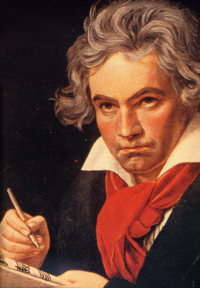 The E flat symphony is often described Grand. It is grand in the sense of its scale. Beethoven doubled the size of the orchestra and the length of the symphony. But it really does not capture the intensity of the quantum leap this symphony imposed to the music evolution as well as the endurance of the audience.
Let’s put this in perspective. The gap between this symphony – his Third – and the Second symphony, which it followed by an interval of only one year, is so deep and wide that perhaps only Beethoven himself was readily to comprehend the new intellectual conception.
When it was performed in first audition in 1804, at prince Lobkowitz’s court, it was dedicated to Napoleon. Upon hearing the news that Napoleon was proclaimed Emperor of the French in May 1804, Beethoven became disgusted, scratched the name Bonaparte out so violently with a knife that he punched a hole in the paper. According to Ferdinand Ries, friend and student of Beethoven:
In 1803 Beethoven composed his third symphony (now known as the Sinfonia Eroica) in Heiligenstadt, a village about one and a half hours from Vienna….In writing this symphony Beethoven had been thinking of Buonaparte, but Buonaparte while he was First Consul. At that time Beethoven had the highest esteem for him and compared him to the greatest consuls of ancient Rome. Not only I, but many of Beethoven¹s closer friends, saw this symphony on his table, beautifully copied in manuscript, with the word “Buonaparte” inscribed at the very top of the title-page and “Luigi van Beethoven” at the very bottom. Whether or how the intervening gap was to be filled out I do not know. I was the first to tell him the news that Buonaparte had declared himself Emperor, whereupon he broke into a rage and exclaimed, “So he is no more than a common mortal! Now, he too will tread under foot all the rights of man, indulge only his ambition; now he will think himself superior to all men, become a tyrant!” Beethoven went to the table, seized the top of the title-page, tore it in half and threw it on the floor. The page was later re-copied and it was only now that the symphony received the title Sinfonia Eroica. - From Biographische Notizen über Beethoven, F. Wegeler and F. Ries, 1838
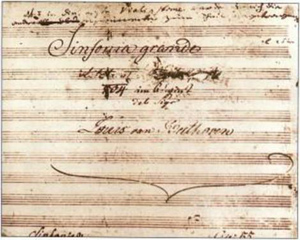
Title Page, where Napoleon's name shown erased
The first public performance took place in Vienna on April 7, 1805. Clearly some audience felt the suffer and outraged with the incomprehensible passage, as one concert goer yelled: “I’ll give another Kreutzer if it will just stop.” Even the most equipped music critics had difficulties to grasp the spirit of a whole new set of resonances, “At any rate this new work by Beethoven has great daring ideas, and, as can be expected from the genius of this composer, is very powerfully carried out. But the symphony would gain immensely (it lasts a full hour) if Beethoven would decide to shorten it and introduce into the whole more light, clarity and unity….”, as the Allgemeine Musikalische Zeitung reviewed.
The listeners did not really have a choice. They had to surrender themselves to the unparalleled passion, the irresistible outburst of creative energy, and the impeccable mastery exhibited in Beethoven’s musical creations. It did not take long for people to start to recognize that the Eroica, or heroic, symphony is impersonal as the tomb of the unknown soldier, a monument to the deathless spirit of man. It is as if a mysterious destiny, in causing Beethoven agony by tearing down an idol before his eyes, had taken the ultimate pains to insure the greatest destiny for his creation. We have in this work not a personal outpouring so much as a masterpiece which balances form and profound feeling, and looks down from its height on the music of two centuries.
In this monumental transformation, Beethoven clothed symphonic forms in a dramatic atmosphere that he forced the delicate, chamber-music style of the symphony to give way to a new abundance of chords, to music that speaks in thunder tones of mighty power. Through his music, we feel the dynamics charged with explosive energy, as if man had become once an elemental being, passionate and wild with unstoppable desire to inner freedom and liberty. Music once for all became the language of humanity, through the funeral marches and fantastic scherzos, as well as prayers and hymns whose solemnity had never before been claimed. “What is beautiful in science is the same thing that is beautiful in Beethoven. There’s a fog of events and suddenly you see a connection. It expresses a complex of human concerns that goes deeply to you, that connects things that were always in you that were never put together before”, as Victor Weisskopf points out.
The revelation was elevated to a new height in his Fifth symphony in C minor. This is undoubtedly, in my opinion, the highest expression humanly possible to disclose inner confrontation, struggle, and will to overcome. It is timeless, boundary-less, and universal. Guided by its powerful opening motif, the C Minor Symphony conveys one of the fundamental elements of human beings by steering the listener “from night to light,” from defeat to triumph.
Beethoven himself conducted the premiere of his Fifth Symphony, performed together with the Sixth Symphony (“Pastorale”), in Vienna on Dec. 22, 1808. In the same Allgemeine Musikalische Zeitung, celebrated author, composer, and music critic Ernst Theodor Wilhelm Hoffmann (January 24, 1776 – June 25, 1822) offered the following:
Radiant beams shoot through the deep night of this region, and we become aware of gigantic shadows which, rocking back and forth, close in on us and destroy all within us except the pain of endless longing – a longing in which every pleasure that rose up amid jubilant tones sinks and succumbs. Only through this pain, which, while consuming but not destroying love, hope, and joy, tries to burst our breasts with a full-voiced general cry from all the passions, do we live on and are captivated beholders of the spirits.
Do you feel the power and the inspiration now?
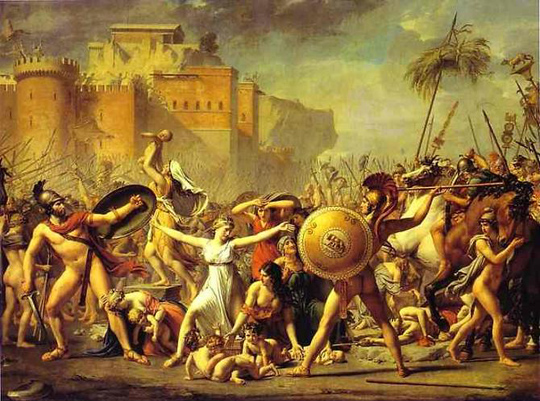
Jacques-Louis David (1748-1825)

Tags: Beethoven, Classical Music

Tags
Archives
Translator

One comment
Leave a reply