Ode to Joy – Part II
A Celebration of Life – On Beethoven’s Birthday
As the century was about to turn, the entire Europe was rattled by the French Revolution politically. But that didn’t seem have much immediate impact on the music world in Vienna. Music enthusiasts were still consumed by the fertile variety delivered to them by the classical masters. In 1788, the three “Great” symphonies of Mozart, the E-flat (K.543), the G Minor (K.550), and the “Jupiter” Symphony, Symphony in C Major (K.551), were premiered. In 1795, Haydn completed the 12 London symphonies. Those were the finest artistic expressions in the symphonic repertoire of these maestros.
Prelude To A Storm
On the second of April, 1800, a benefit concert was announced in Vienna. Tickets and stalls were to be had of “Herr van Beethoven at his lodgings im tiefen Graben, No. 241, third story, and of the boxkeeper”. Concert programs, as printed on the announcement, included
A new grand symphony for full orchestra by Beethoven.
A symphony by the late chapel-master Mozart
An aria and duet from Haydn’s Creation
A grand concerto for pianoforte, played and composed by Beethoven, and
A septet for four strings and three wind instruments, composed by Beethoven
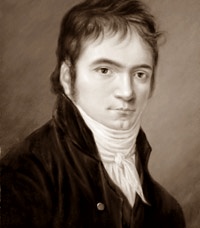
Young Beethoven
Unlike his fellow musicians in Vienna, “Beethoven is the friend and contemporary of the French Revolution, and he remained faithful to it even when, during the Jacobin dictatorship, humanitarians with weak nerves of the Schiller type turned from it, preferring to destroy tyrants on the theatrical stage with the help of cardboard swords. Beethoven, that plebeian genius, who proudly turned his back on emperors, princes and magnates – that is the Beethoven we love for his unassailable optimism, his virile sadness, for the inspired pathos of his struggle, and for his iron will which enabled him to seize destiny by the throat.” – Igor Stravinsky
It never was doubtful in Beethoven’s mind that he was about to transform music. In his first symphony, he tried to respect the forms and standards of Haydn and Mozart, restrained himself to confine in their mold. But even with his first entry to the symphonic repertoire, the C major symphony clearly revealed the cloven hoof of the revolutionist beneath. Though the third movement of the symphony retaines the name of the Mozartian minuet, it is obvious a suggestion of something much more energized – a Scherzo.
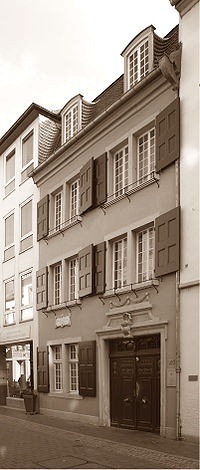
Born on December 16th, 1770, in Bonn
Compare to his later symphonies, the C major is hardly a “major” piece in his music output. But, in 1800 this was nothing short of major, because even his contemporaries realized that this piece changed the conception of the genre, that this symphony represented Beethoven at the height of his Classical powers, building on the achievements of Haydn and Mozart while not hiding his debt to them. The First Symphony, as described by his contemporaries, is “a masterpiece that does equal honor to [Beethoven's] inventiveness and his musical knowledge. Being just as beautiful and distinguished in its design as its execution, there prevails in it such a clear and lucid order, such a flow of the most pleasant melodies, and such a rich, but at the same time never wearisome, instrumentation that this symphony can justly be placed next to Mozart’s and Haydn’s.”
But, still, no one realized this would actually put a period to their beloved classicism.
Despite his deteriorating hearing, and the suicidal thoughts he expressed in an unsent letter to his brothers, Heiligenstadt Testament, Beethoven injected boundless humor and vitality into his second symphony, the D major written in 1802. “This Symphony is smiling throughout”, as Hector Berlioz later remarked. In this symphony, the Minuet is officially replaced with the Scherzo. It might be Beethoven’s way of seeking refuge in the charm of music at the time of his personal struggle.
Nevertheless, maybe by now his contemporaries began to realize that the music language of Beethoven and the energy he exerted in his symphonies, so far only two, were not temporary experiments but, indeed, a representation of a revolution they were not ready for. The reaction to the second symphony, shockingly, was politely dissenting: “It is a noteworthy, colossal work, of a depth, power, and artistic knowledge like very few. It has a level of difficulty, both from the point of view of the composer and in regard to its performance by a large orchestra (which it certainly demands), quite certainly unlike any symphony that has ever been made known. It demands to be played again and yet again by even the most accomplished orchestra, until the astonishing number of original and sometimes very strangely arranged ideas becomes closely enough connected, rounded out, and emerges like a great unity, just as the composer had in mind.”
But, Beethoven had determined to recover from his depression, to throw himself with renewed vigor into the work of musical creation. He did the unthinkable. He turned his deafness, a catastrophe for a composer, to motivation. He turn the criticism into challenge. He’s about to storm the world with the historical Eroica.
Was the world ready?
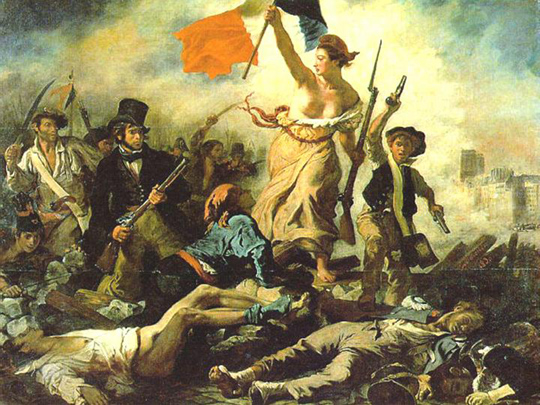
"Liberty leading the People" by Eugène Delacroix

Tags: Beethoven, Classical Music

Tags
Archives
Translator

Leave a reply